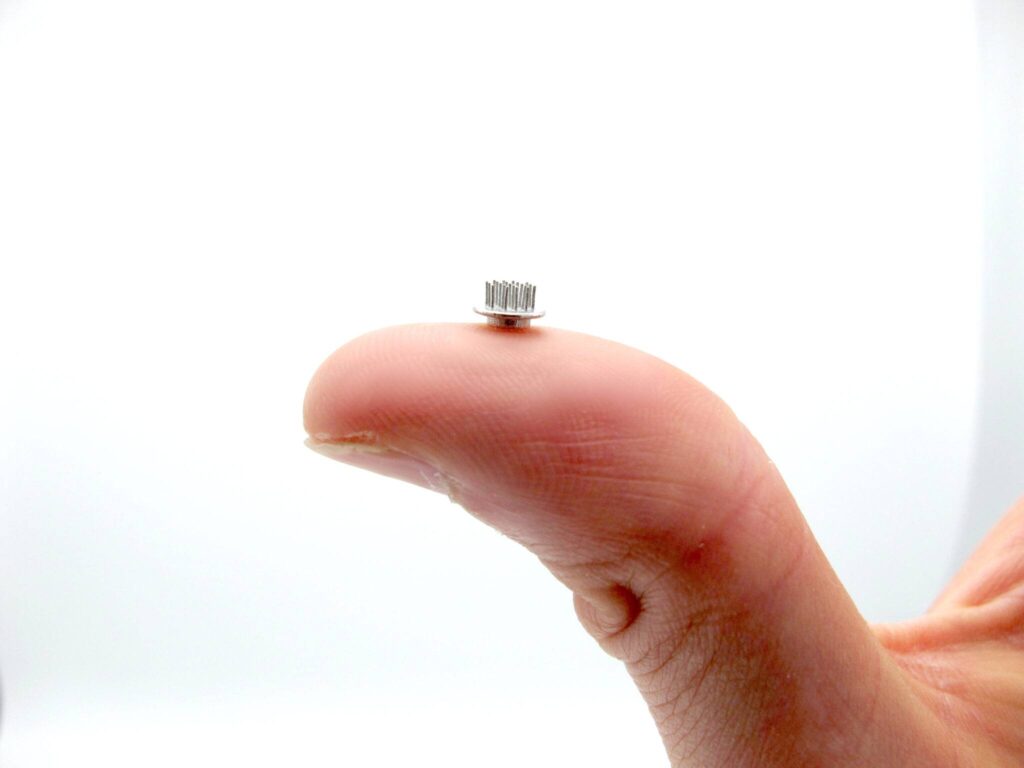
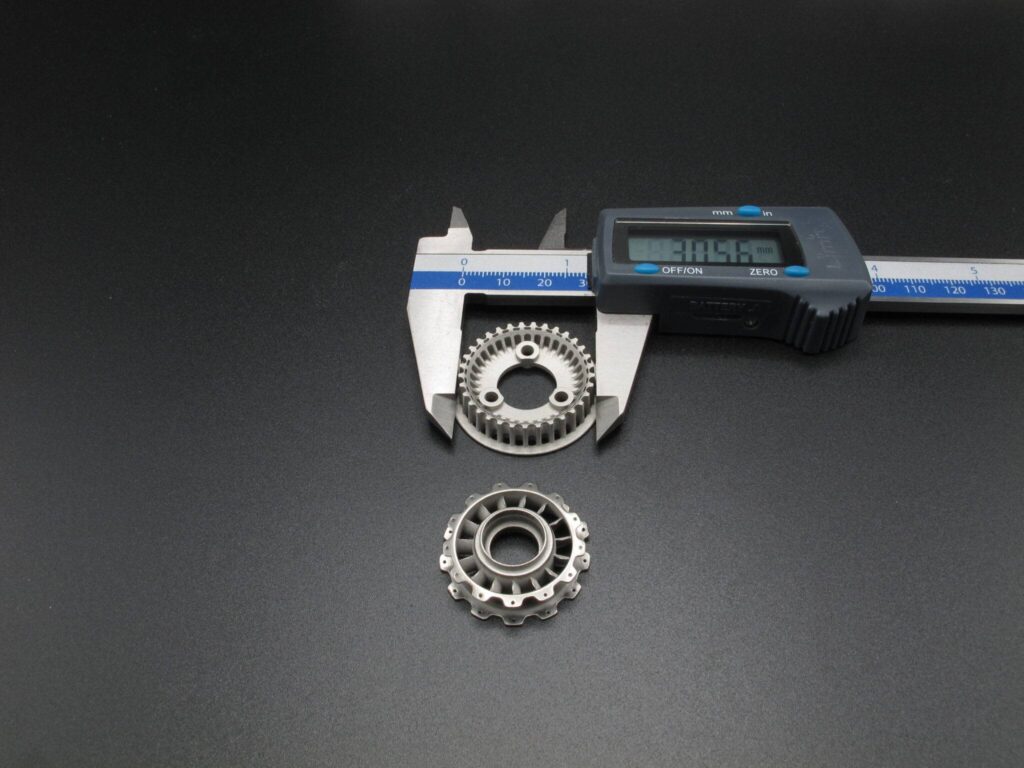
Binder Jetting (BJ) can produce small details in metal with very high detail. The process binds metal powder to the shape of the part and is then sintered into a fully solid metal part without pores. The part is printed on a larger scale and then shrinks to the desired size during the sintering process. The scaling is difficult to get exactly right, which means that this process has a relatively large tolerance range. The result in terms of the material properties is very similar to the properties you get through traditional sintering of metal, but through Binder Jetting you can get completely different types of geometries. After sintering, the 3D printed parts can be polished in various ways to achieve the desired finish. Another method of 3D printing in metal is DMLS. Not sure which process suits your purpose best? click here.
Process data
Value
Standard tolerance
± 5% (lägsta gräns ±0.1 mm).
Max. component size
155 x 155 x 76.2 mm
My. component size
10 x 7.5 x 1.0 mm
*the above data are best-practice and may vary and depend on the choice of material.
*click to enlarge*
Materials for 3D Printing - BJ
Stainless steel, 316L, 1.4404
316L is an austenitic stainless steel based on the AISI 316L standard. Its composition ensures high corrosion resistance where molybdenum adds to resistance in chloride environments. It offers excellent elongation and ductility, as well as being non-magnetic. It is used in a wide range of application areas from dental/medical through consumer electronics and aerospace to designer items.
Excellent corrosion resistance
Good strength at moderately elevated temperatures
Responds well to surface treatment eg super finish
Molybdenum gives improved corrosion resistance
Material data Stainless steel, 316L
Material data
Unit
Value
Tensile strength
MPa
520
Elastic limit
MPa
180
Elongation at break
%
50
Hardness
HRB
55
Relative density
%
97
Values above are approximate and actual values may vary.