
Stereolithography (SLA) is suitable for visualization models where there are high demands on surface finish and detail. SLA is a resin-based process where liquid is hardened by one or more light beams into the desired shape. The quality of the surfaces is already very high immediately after printing, but can be further improved to achieve transparent or high-gloss results for chromating and varnishing of various kinds. The materials for SLA are thermoplastics, which means that they are relatively brittle and sensitive to UV light and moisture. Other methods for 3D printing that we work with include: SLS Printing. Are you unsure which process suits your purpose best? Then click here!
| Process data | Value |
|---|---|
| Standard tolerance | ± 0.3% (minimum limit ±0.3 mm) |
| Layer thickness | 0.1 mm |
| Minimum wall thickness | 2 mm |
| Minimal detail | 1 mm |
| Largest component size | 2000 x 700 x 788 mm |
*the above data depends on the choice of material.
*click to enlarge*
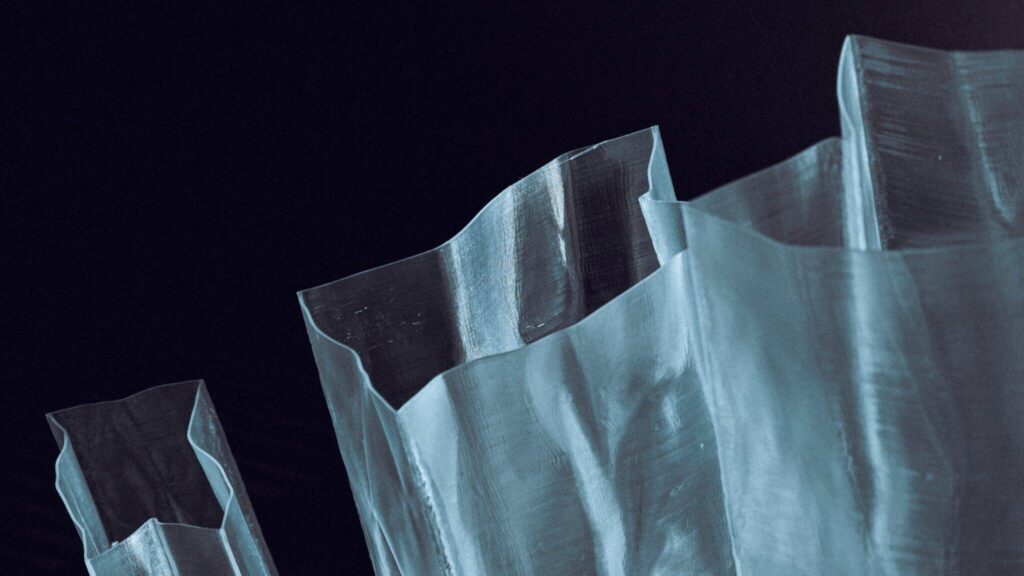
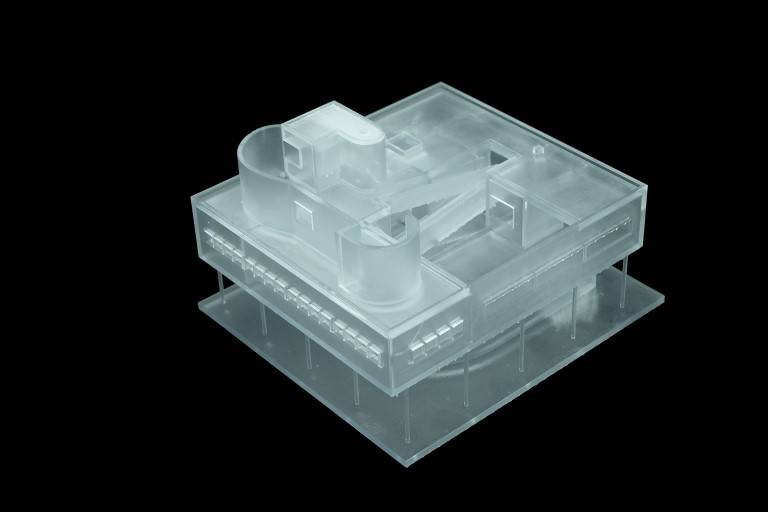
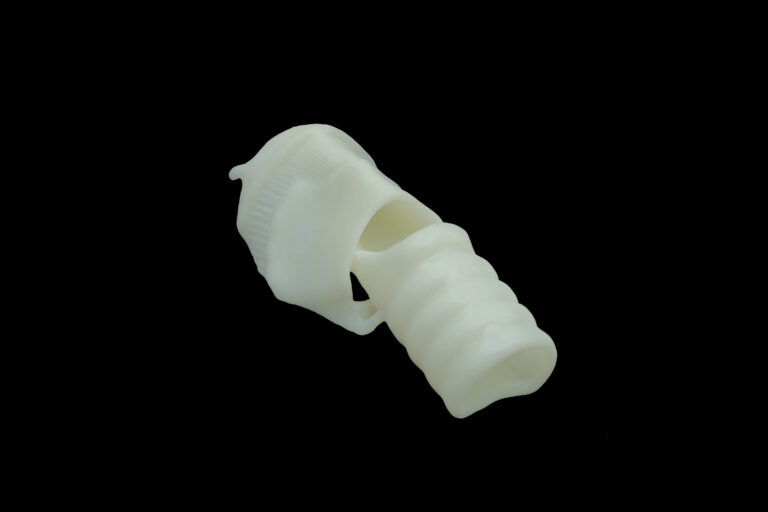
PG 420 is a versatile thermoset that is well adapted to suit most applications. It has good mechanical properties and high surface finish. It is often used to demonstrate full product assemblies, visualization and architectural models, and prototypes. Like all materials for SLA, PG 420 is sensitive to UV light and moisture.
| Material data | Unit | Value |
|---|---|---|
| Tensile strength | MPa | 43 ± 1 |
| E-module | MPa | 2250 ± 60 |
| Flexural strength | MPa | 68 ± 10 |
| Flexural modulus | MPa | 2070 ± 80 |
| Notched Izod impact test | J/m | 21 ± 1 |
| Water absorption | % | 0.7 |
| Elongation at break | % | 11 ± 4 |
| Shore D Hardness | – | 87 ± 5 |
| Density | MPa | 1.18 |
| Heat resistance temperature (1.8 MPa) | °C | 45 |
XC Transparent is a strong thermoset that is perfect for prototypes, visualization models and flow analyses. With the right post-processing, such as polishing and clearcoating, completely transparent models can be achieved. Like all materials for SLA, XC Transparent is sensitive to UV light and moisture. XC Transparent has a slight blue tone.
| Material data | Unit | Value |
|---|---|---|
| Tensile strength | MPa | 50 ± 4 |
| E-module | MPa | 2770 ± 110 |
| Flexural strength | MPa | 69 ± 5 |
| Flexural modulus | MPa | 2200 ± 160 |
| Notched Izod impact test | J/m | 25 ± 5 |
| Water absorption | % | 0.36 |
| Elongation at break | % | 15 ± 5 |
| Shore D Hardness | – | 80 ± 3 |
| Density | MPa | 1.15 |
| Heat resistance temperature (1.8 MPa) | °C | 45 |
SLA (Stereolithography) is one of the most popular 3D printing techniques used to create complex and precise objects. In SLA printing, a UV laser is used to harden a photosensitive resin in a layer-by-layer process. When the resin has hardened, they are joined into a 3D object.
SLA printing is one of the most used techniques in 3D printing, and offers opportunities to create complex and precise objects with high speed and reliability. With a wide palette of finishing and a fast process, SLA printing is a powerful tool for prototyping and making models during the product development process.
We’re ready to get started on your project and bring your ideas to life. Simply reach out to us, share your requirements, and let us know how we can assist you. Upload any relevant documents, 2D drawings, 3D models, or specific product requirements, and we’ll walk you through every step of the process to help you achieve your goals.
We look forward to collaborating with you!

We are a comprehensive enterprise supplier, delivering high-quality end products and prototypes through advanced manufacturing techniques, including additive manufacturing and CNC machining in metal, plastic, and composite.